
The AI revolution has impacted many sectors, including art, IT, and marketing, and has even reached the world of chess. There are now lots of AI coaches available at quite low prices, which makes you wonder whether it’s worth paying more for a human coach.
That’s the question we will try to answer in this post. Our article is based on analysing numerous reviews from different users and insights we received from chess coaches at Mindful Chess who tested the AI tools.
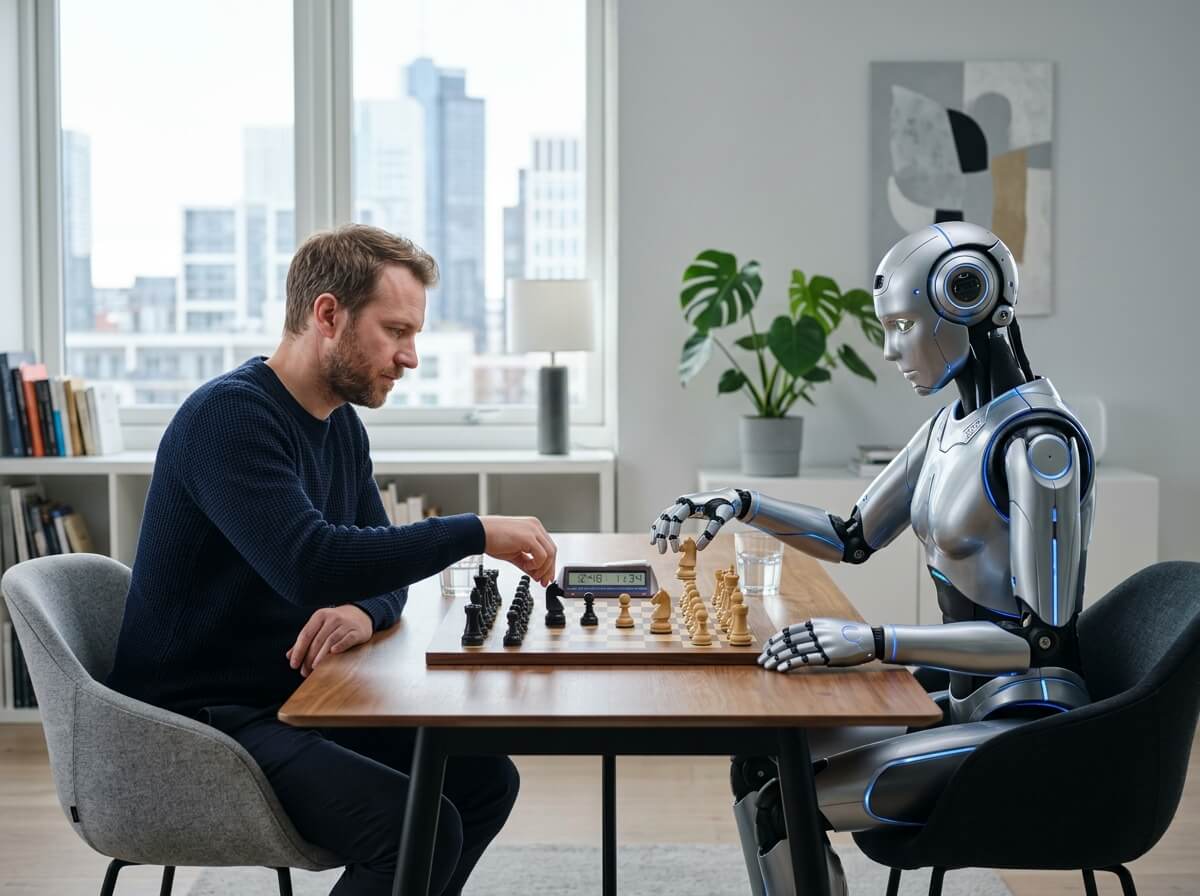
What an AI chess coach and a human coach do
Before comparing them, it’s worth being clear on what each one actually is.
How an AI chess coach works
An AI chess coach is software that reviews your games for you. You connect your account from a site like Lichess or Chess.com, and the tool pulls your games automatically. It runs them through a chess engine and turns the result into something readable. For example, a label for each move (best, excellent, a miss, a blunder) and a short written explanation of what went wrong or good.
Some go a little further. A few let you ask follow-up questions about a position, and others let you play against the AI while it comments on your moves as you go.
What a human chess coach does
A human coach works with you directly. That usually means regular lessons, going through your games together, and a study plan based on what you need to improve. With online chess coaching, the lessons are via video call, so your coach can be based anywhere in the country, or abroad.
It’s an ongoing arrangement rather than a one off review, which is the main thing that separates the two approaches.
Cost and availability
We’ll start with what the AI tools clearly win on, because it’s a real advantage and worth being honest about.
The first is cost. A human chess coach in the UK usually charges somewhere between £20 and £75 an hour, depending on their rating and experience, and regular lessons add up. Most AI coaches, by contrast, are free or cost a few pounds a month. For that, you can run every game you play through the tool, not just the two or three you’d have time to go over in a lesson.
The second is availability. There’s no booking and no waiting for your slot. If you finish a frustrating game at eleven at night, the analysis is ready before you go to bed, while the moves are still fresh in your head. That’s often the best time to review a game, and a human coach can’t match it.
How well does the AI coach explain why a move is wrong?
This is where the gap between the two options really shows, and it’s the main reason we’d point most players towards a human coach.
The problem is in how an AI coach produces its explanations. It works out the engine’s preferred move, then provides an explanation. That sounds fine, until you notice that the answer usually describes what the engine wants rather than the actual reason behind it. When the real reason takes a few moves of calculation to see, the AI tends to miss it completely.
A couple of examples from games coaches ran through these tools make the point.
In one position, the tool flagged a queen move as a mistake and said the player had missed a better way to keep the queen safe. That reads like sensible advice. The real problem was that the queen was about to be trapped a couple of moves later, with no safe square left for it at all. “Keep the queen safe” says nothing about that. The player learns the move was wrong, but not why, and not the idea that actually mattered.
In another, the tool recommended a pawn move and explained that the point was to prepare the bishop for development. The move was right, but the reason was not. The real point of the move was to trap the opponent’s queen, which is a completely different concept from the one suggested by the AI. A player who reads the explanation at face value comes away with the wrong lesson, even though the move itself was correct.
This happens because the AI is, in effect, describing the engine’s top choice rather than reasoning about the position. When the answer is simple, that’s good enough. When it depends on looking three or four moves ahead, the explanation thins out into something generic, or points at the wrong thing entirely.
A coach does the opposite. A coach will explain the mistake, play through the variations that prove why it is wrong, making sure you do not walk away with the wrong lesson. The explanation is the whole point of the lesson, not a label fixed onto an engine’s output.
Spotting patterns across your games
An AI coach looks at each game on its own. It’s good at telling you what went wrong in the game in front of it, but it doesn’t really join the dots between this game and the fifty before it. Also, you should know that the report resets every time.
A coach who has worked with you for a few months sees the thread. They notice that you go passive in the middlegame, or rush your endgames, or play well when you’re ahead and fall apart the moment you have to defend. None of that shows up in one game. It shows up in the pattern across many of them, and a person watching over time is the one who picks it up.
This matters because the pattern is usually the thing actually holding you back. You can fix one blunder this week and make the same kind of mistake again the next. Knowing that you have a recurring habit, and what it is, tells you where to put your effort. A stack of separate game reports rarely adds up to that on its own.
How reliable is AI chess analysis?
There’s a separate issue worth knowing about, which is how far you can trust the output in the first place.
Run the same game through the game analysis (even on chess.com) twice and you can get different results. A move marked as a blunder the first time comes back as a miss on the second pass. Our coaches saw this more than once: refresh the page, get a different verdict on the same game. If the labels move around like that, they’re a rough guide at best, not a verdict to rely on.
The analysis can also be plainly wrong for the position, suggesting a move or a plan that doesn’t fit. Most of the time, that won’t do much harm. The trouble is you usually can’t tell which assessments are sound and which aren’t, so there’s a real chance of taking the wrong idea on board without noticing. The better you get, the more this costs you, because at that level the gap between a good move and a slightly worse one is the exact thing you’re trying to learn.
A coach is accountable for what they tell you. They won’t give you a different read on the same game an hour later, and if they’re unsure, they’ll say so rather than state it with false confidence. You know precisely who is guiding you, and that level of trust is key to learning from the advice.
Motivation, accountability and a study plan
A booked lesson on Thursday changes how you prepare for it. You study because someone is going to go through your games with you, and because you’d rather not turn up having done nothing. An app can send you a reminder, but it can’t make you care whether you’ve done the work. That bit of accountability is hard to copy in software.
A coach also turns what they’ve noticed into a plan. Once they know the habit that’s holding you back, they decide what you work on next, in what order, and adjust it as you go. They push when you’ve gone quiet and ease off when you’re overloaded, and they tell you when something has clicked. None of that is a feature you can switch on; it comes from a person paying attention to you in particular.
So what’s the verdict?
For most players who are serious about improving, a human coach is the better choice. The AI tools win on cost, availability and volume, and that’s worth having. But the things that move your chess along, an explanation that gives you the real reason, someone who knows your recurring weaknesses, advice you can trust, and the accountability to keep at it, are still the human coach’s territory.
That doesn’t mean the AI tools have no place. Used for what they’re good at, they’re a sensible addition. Run your games through one for a quick daily review between lessons, then take the ones you don’t understand to your coach. Utilise the app for immediate automated feedback, but trust a coach to map out your genuine path forward.

