
What are Enzymes and what do they do?
Enzyme Action, Activity and Nutrition Quiz
4.0 out of 5 stars (based on 25 reviews)
What are Enzymes?
Enzymes are proteins that act as biological catalysts. This means that they speed up useful reactions in the body, without being used up. Enzymes play an important role in cellular respiration and photosynthesis.
Enzymes are comprised of long chains of amino acids and have a very important feature called an active site. The active site is a region on an enzyme that has a particular shape. This shape is complementary to a specific substrate, which can be thought of as a reactant.
The specificity of the complementary pairs of enzymes and substrates means that different enzymes are necessary to catalyse different reactions. As the active site of one enzyme matches and joins up with its substrate, a reaction is catalysed and afterwards, the substrate can be considered a product.
Why are Enzymes also called Biological Catalysts?
Enzymes increase the speed of reactions without being used up, making them catalysts. They are also produced biologically and so sometimes they are called biological catalysts which speed up the useful reactions in our bodies.
An example of a useful reaction is the digestion of complex molecules like starch into maltose, allowing our bodies to gain nutritional value from our food.
What Happens to Enzymes at High Temperatures?
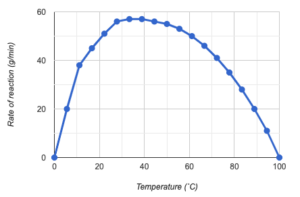
Since enzymes are proteins made of chains of amino acids, these chains have the potential to be disrupted. When temperatures rise above a certain level, this causes the chains to buckle and bend. As a result, the shape of the active site changes and is no longer complementary to its substrate. This means that the substrate cannot fit in the active site and no reaction can be catalysed.
Increased temperatures means faster moving enzymes and substrates, this increases the frequency of collisions between enzyme-substrate pairs. There is naturally an optimum temperature for reactions and that is why our body works so hard through homeostasis to maintain stable body temperatures at around 37˚C.

Why the Digestive System Needs Enzymes
Enzymes are catalysts for biological reactions, including one which we are all familiar with, digestion. When we consume foods we are asking our bodies to convert the form of the meal into a useful form.
We need to eat in order to gain energy but we also need other important substances such as proteins for the growth of our muscles as well as repair.
We often fail to remember that the food we eat was once inside other plants and animals. If we want to convert food into useful forms, we first need to break it down and then reform it. What this means is we need to digest our food and the mechanism by which we do that is through various digestive enzymes.
We digest large, stable molecules such as starch which is found in plants like rice, into smaller forms like maltose. In the case of starch, which is a polymer, we use amylase to break it down into maltose, which is a monomer. We consistently break down polymers into monomers and then re-form them with other enzymes such as glycogen synthase.
Part of the goal of breaking down molecules such as starch is to get the glucose it contains to our muscles where it can be used for respiration. This involves passing through the intestines via active transport and so the molecules are broken down into smaller, more soluble ones. Processing glucose through respiration and then excreting the waste products is part of the carbon cycle.
If we were unable to exploit enzymes to aid our digestion, we would be unable to perform our essential functions in our cells and in addition, malnutrition would cause vulnerability to diseases.
What are the Building Blocks of Proteins and other Polymers?
Proteins are polymers that are made from monomers called amino acids. These are formed by long chains of amino acids which are folded and arranged in complex ways to achieve different functions, such as being enzymes. The active site of enzymes is determined by the shape of the amino acid chains of the enzyme.
Remember these polymers and their monomers, the digestive system must break down (with the help of enzymes) insoluble polymers into soluble monomers so they can be absorbed into the blood.
| Polymer | Monomer | Enzyme |
|---|---|---|
| Starch | Glucose | Amylase |
| Glycogen | Glucose | Carbohydrases |
| Fats/Oils | Fatty acids/Glycerol | Lipases |
| Proteins | Amino acids | Proteases |