
Do you know the difference between diffusion and osmosis?
Diffusion, Osmosis and Active Transport Quiz
4.5 out of 5 stars (based on 62 reviews)
Factors that Affect the Rate of Diffusion
Diffusion is the random movement of particles from areas of high concentration to low concentration. This rate is not fixed and can be affected by a number of factors. One factor is the temperature of the medium/solvent as well as the temperature of the particles that are moving via diffusion. Warmer particles have more kinetic energy and are thus moving more quickly, leading to an increased rate of diffusion.
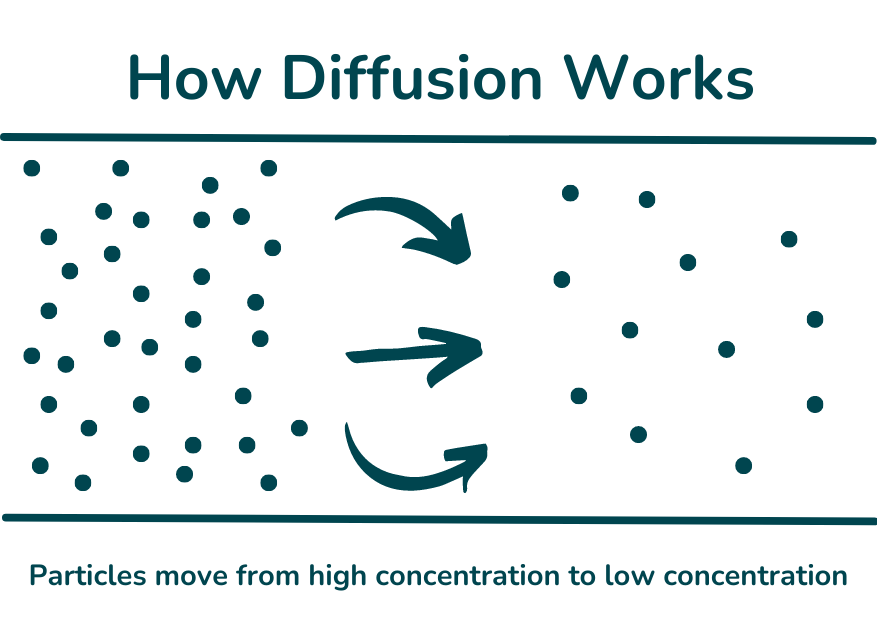
Another factor is the concentration gradient, meaning the difference between concentration in one area and in another. A greater concentration gradient will lead to an increased rate of diffusion from high to low concentration. An additional factor is the size of the surface area available for diffusion. This is because a larger surface area can effectively increase the concentration gradient, not per unit area but overall a concentration gradient is created with each unit of surface area.
What is Active Transport?
Active transport is an active process which requires energy in the form of ATP (adenosine triphosphate), whereas diffusion and osmosis are passive processes. In active transport, substances are moved across the cell membrane using transporter proteins (also known as carrier proteins) and ATP. Active transport moves substances against the concentration gradient.
An example of active transport is moving mineral ions from the soil into the root hair cells. The roots already contain a higher concentration of ions than the soil, but they still need more to transport around the plant and so they must use energy to actively transport them.
Why is Diffusion Important to Animals and Plants?
Diffusion is an essential process for plants and animals in order to maintain their internal body conditions (homeostasis) and remove waste products. In the lungs, diffusion facilitates the gaseous exchange after respiration, infusing the blood with oxygen and removing carbon dioxide. Another good example is fish that perform a similar action using their gills as a surface for diffusion. Plants also exchange gases through their stomata using the process of diffusion.