
Famous Landmarks Quiz
What’s in the Famous Landmarks Quiz?
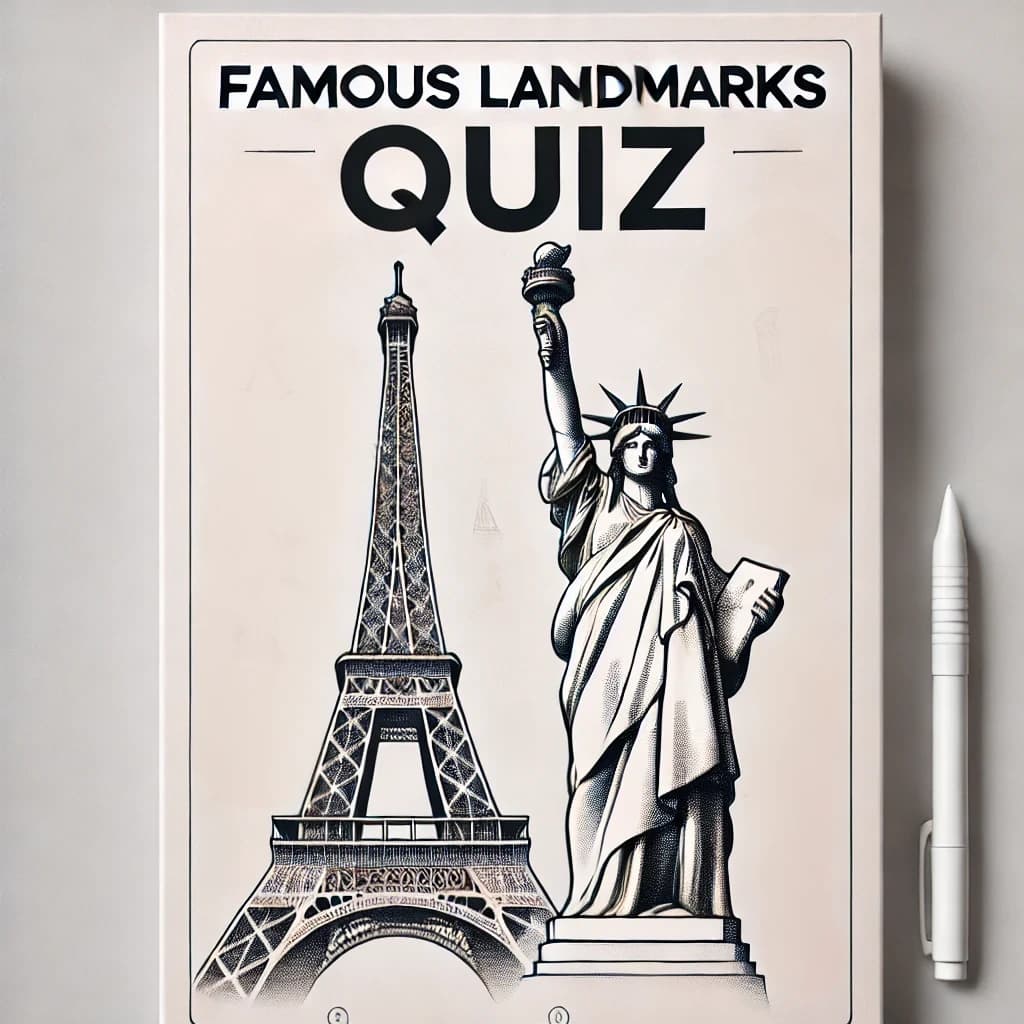
This quiz takes you around the globe to the monuments, natural wonders and feats of engineering that people travel thousands of miles to see. The questions cover:
- Ancient architectural marvels that have stood the test of time
- Natural wonders shaped by millions of years of geological processes
- Engineering achievements that pushed the boundaries of human capability
- Sacred sites that have inspired people for centuries
Some landmarks are defined by the sheer scale of human effort behind them. The Great Wall of China took the longest of all to construct, with sections added by successive dynasties over many centuries until it snaked for thousands of miles across the country’s northern frontier. Ancient builders left wonders on almost every continent, from the rose-red city of Petra carved into the cliffs of Jordan to the mountaintop citadel of Machu Picchu in Peru and the vast temple complex of Angkor Wat in Cambodia. Each of these sites rewards a little knowledge of where it sits and why it was built, which is exactly the kind of detail this quiz likes to test.
Europe alone is packed with instantly recognisable structures. The Eiffel Tower has crowned the Paris skyline since 1889, when it was built for the World’s Fair and initially dismissed by critics before becoming the very symbol of France. Rome’s Colosseum once held tens of thousands of spectators for gladiatorial games, and the Leaning Tower of Pisa has tilted gently for centuries thanks to soft ground beneath its foundations. Knowing which famous landmarks share a continent is a classic quiz challenge, and grouping the Eiffel Tower, the Colosseum and the Leaning Tower of Pisa together is a satisfying way to start narrowing down the map.
The natural world supplies just as many showstoppers. The Grand Canyon was carved by the Colorado River over millions of years, exposing rock layers that record more than two billion years of Earth’s history in their banded walls. Niagara Falls thunders across the border between the United States and Canada, one of the rare natural landmarks that spans two different countries. Vietnam’s Ha Long Bay scatters thousands of limestone islands and sea stacks across emerald water, while Australia’s Uluru, the great sandstone monolith once known as Ayers Rock, glows deep red at sunset and holds profound spiritual significance for the Anangu people.
Other sites blur the line between nature and human imagination. High in the Peruvian desert, the Nazca Lines form enormous figures of animals and shapes that can only be made out properly from the air, a mystery that has fascinated archaeologists for decades. On England’s Salisbury Plain, Stonehenge has stood for around five thousand years, its giant stones aligned with the summer solstice sunrise and hauled, remarkably, from sources nearly 200 miles away. In Singapore, the futuristic Gardens by the Bay pair towering “supertrees” with the climate-controlled Cloud Forest conservatory, proving that landmarks are still being created today.
Cities offer their own kind of landmark, woven right into the rhythm of daily life. New York’s Times Square, sitting at the intersection of Broadway and Seventh Avenue, draws huge crowds beneath its dazzling advertising screens, especially on New Year’s Eve. The Statue of Liberty, a gift from France to the United States in 1886, has welcomed arrivals into New York Harbor ever since and remains one of the most powerful symbols of freedom in the world. Berlin’s Brandenburg Gate has witnessed turning points of European history, from Napoleon’s march through the city to the fall of the Berlin Wall, showing how a single monument can carry the weight of centuries.
It is worth remembering how many of these places are formally protected as treasures of the whole planet. UNESCO maintains a World Heritage list that includes Petra, Machu Picchu, Angkor Wat, the Grand Canyon, Stonehenge and Ha Long Bay, recognising their value to all of humanity and helping to fund their preservation. Some landmarks have even been voted into modern lists of wonders: the New7Wonders campaign of 2007 chose the Great Wall of China, Petra, Machu Picchu and the Colosseum among its winners. These honours carry real weight, because the attention they bring shapes tourism, conservation budgets and the way local communities care for sites that have often stood for thousands of years.
The scale and ingenuity of these places never stops surprising people. The Grand Canyon plunges more than a mile deep and stretches some 277 miles along the Colorado River, while Niagara Falls sends millions of litres of water over its edge every minute. Stonehenge’s largest sarsen stones weigh as much as 25 tonnes each, raised without any modern machinery, and the smaller bluestones were somehow moved from the Preseli Hills in Wales. The Statue of Liberty was shipped across the Atlantic in 350 individual pieces and reassembled in New York Harbor, and the Eiffel Tower is made of more than 18,000 iron parts held together by over two and a half million rivets. Details like these turn a simple question into a genuine moment of wonder.
Discovering landmarks is about far more than ticking places off a travel list. Behind each one is a story of ambition, belief, artistry or raw geological force, and learning those stories makes the world feel both larger and more connected. Whether you are an armchair traveller or someone planning the next great trip, this quiz is built to be both a challenge and a tour of humanity’s greatest achievements and nature’s most spectacular creations. Take it, share your score, and see how many of the planet’s most extraordinary places you can place. You can find all the questions and their correct answers by clicking Preview Quiz Content at the bottom of the page.
Preview Quiz Content
This section contains all of the questions that could be a part of this quiz. The quiz will choose 15 random questions from the pool below. If you’ve found this section feel free to take a look but to start the quiz you should press “Start Quiz”. The answers listed below only contain answers that appear in the quiz, so this is supplemental information about the quiz itself and not intended as a comprehensive list. We hope you found the quiz to be entertaining and informative. If you haven’t taken it yet, Good Luck!
Q1: What was the longest to construct?
A1: Great Wall of China
Q2: Which famous landmark was a gift from France to the United States?
A2: Statue of Liberty
Q3: Match each landmark to its location.
A3: Petra – Jordan, Machu Picchu – Peru, Angkor Wat – Cambodia
Q4: Which of these landmarks are located in Europe?
A4: Eiffel Tower, Colosseum, Leaning Tower of Pisa
Q5: Which famous landmark sits at the intersection of Broadway and Seventh Avenue?
A5: Times Square
Q6: Which of these natural landmarks spans across two different countries?
A6: Niagara Falls
Q7: Which famous rock formation in Australia was formerly known as Ayers Rock?
A7: Uluru
Q8: Which famous gardens features the iconic Cloud Forest conservatory?
A8: Gardens by the Bay
Q9: Which famous landmark was created by erosion from the Colorado River?
A9: The Grand Canyon
Q10: Which ancient stone circle is aligned with the summer solstice?
A10: Stonehenge
Q11: Which famous bay in Vietnam contains thousands of limestone islands?
A11: Ha Long Bay
Q12: Which desert landmark features mysterious lines visible only from above?
A12: Nazca Lines