Do you know where oxidation takes place?
Electrolysis Quiz
4.2 out of 5 stars (based on 29 reviews)
Time limit: 0
Quiz Summary
0 of 13 Questions completed
Questions:
Information
You have already completed the quiz before. Hence you can not start it again.
Quiz is loading…
You must sign in or sign up to start the quiz.
You must first complete the following:
Results
Quiz complete. Results are being recorded.
Results
0 of 13 Questions answered correctly
Your time:
Time has elapsed
You have reached 0 of 0 point(s), (0)
Earned Point(s): 0 of 0, (0)
0 Essay(s) Pending (Possible Point(s): 0)
| Average score |
|
| Your score |
|
Categories
- Not categorized 0%
- 1
- 2
- 3
- 4
- 5
- 6
- 7
- 8
- 9
- 10
- 11
- 12
- 13
- Current
- Review
- Answered
- Correct
- Incorrect
-
Question 1 of 13
1. Question
What is an electrolyte?
CorrectIncorrect -
Question 2 of 13
2. Question
Use some of the following words to fill in the blanks:
Active, direct, indirect, electrical, magnetic
-
Fill in the blanks: Electrolysis is a process in which energy from a current supply is used to decompose electrolytes.
Correct 2 / 2 PointsIncorrect / 2 Points -
-
Question 3 of 13
3. Question
During electrolysis which electrode do anions and cations migrate to?
CorrectIncorrect -
Question 4 of 13
4. Question
Complete the following half equation for a reaction the cathode during electrolysis of molten zinc chloride. Zn²⁺ + ….. → Zn
CorrectIncorrect -
Question 5 of 13
5. Question
Complete the following half equation for a reaction the cathode during electrolysis of molten lead bromide. Pb²⁺ + 2e → …..
CorrectIncorrect -
Question 6 of 13
6. Question
Which electrode would the ion Mg²⁺ migrate to during electrolysis?
CorrectIncorrect -
Question 7 of 13
7. Question
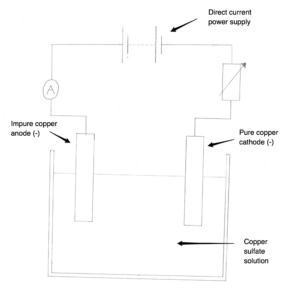
Copper can be purified using electrolysis of copper sulfate solution. For this process, we use the setup in the image below. Complete the half equation for the reaction at the anode. Cu → ….. + …..
 CorrectIncorrect
 -
Question 8 of 13
8. Question
Copper can be purified using electrolysis of copper sulfate solution. For this process, we use the setup in the image below. Complete the half equation for the reaction at the cathode. Cu²⁺ + 2e →
CorrectIncorrect -
Question 9 of 13
9. Question
When using inert electrodes to perform electrolysis with copper chloride solution, which products will be produced at the anode and cathode?
CorrectIncorrect -
Question 10 of 13
10. Question
When using inert electrodes to perform electrolysis with sodium chloride solution, which products will be produced at the anode and cathode?
CorrectIncorrect -
Question 11 of 13
11. Question
[question number = 06.2] When using inert electrodes to perform electrolysis with sodium sulfate solution, which products will be produced at the anode and cathode?
CorrectIncorrect -
Question 12 of 13
12. Question
When using inert electrodes to perform electrolysis with water acidified with sulfuric acid, which products will be produced at the anode and cathode?
CorrectIncorrect -
Question 13 of 13
13. Question
[question number = 06.1] When using inert electrodes to perform electrolysis with molten lead bromide, which products will be produced at the anode and cathode?
CorrectIncorrect