GCSE OCR Physics B Paper 2

Mock test. 1 hour and 45 minutes. 90 marks available.

Each time the test is taken it will present different questions.

Good Luck!

 
QUIZ START

Results

Well Done you passed the test! You’re on your way to getting the grades you want!
OCR Physics B Paper 2

Why not try another Science Mock Exam and see how well you do?

Nice try, check your answers to see where you went wrong.

OCR Physics B Paper 2

Why not get a bit more practice with some physics quizzes and then come back and have another try!

#1. What wavelength of the electromagnetic spectrum is useful for communications?

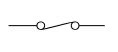
#2. What is this component?

#3. What is this component?

#4. Which of the following statements is correct?

#5. Is geothermal renewable?

#6. What does E represent in the equation for work done?

#7. Is displacement a vector or a scalar?

#8. What do we call energy that is stored in twisted or stretched materials?

#9. Which of the following best describes energy?

#10. Why does the temperature of a material stay constant during the transition from liquid to gas?

#11. What is this component?

#12. Find the volume of a silver block that has a mass of 159g and a density of 10.49 g/cm³. Give your answer in cm³ and to 1 decimal place.

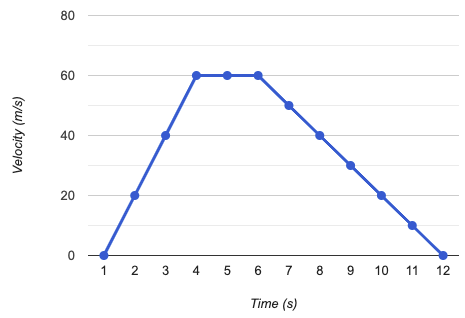
#13. Calculate the distance travelled by the runner in the velocity/time graph.

The area under the graph = distance travelled

Split the graph into triangles and rectangles and calculate the areas. Then add together the areas.

Area of a rectangle = Length x Height

Area of a triangle = 1/2 x Length x Height

90m 120m 180m = 390m

NOTE: the graph starts at one second and not 0. Don’t be fooled, look at the axes carefully before attempting a question.
#14. Which of the following is an advantage of using nuclear fission power plants?

#15. What is the function of a fuse?

#16. Magnesium is a magnetic material – true or false?

#17. The force on a conductor carrying current at right angles to a magnetic field is expressed by which of the following equations?

#18. What are fossil fuels?

#19. What is this Sankey Diagram showing?

#20. Why would a wire carrying a current experience a force near a magnetic field?

#21. Why is the total energy transferred to a kettle’s heating element, more than the total energy of the boiled water inside the kettle?

If you could accurately measure the movement of energy, you would always find that all of the energy is transferred. Energy cannot be created or destroyed, this is known as the Law of Conservation of Energy.

#22. Which scientist proposed the Plum Pudding Model?

#23. When moving from air to glass, what will happen to a wave’s speed?

#24. The melting point of gallium is 29.8˚C and the boiling point is 2204˚C. What state is gallium at 25˚C?

#25. What is the approximate radius of a nucleus?

#26. What is displacement?

#27. Jack moves a cube weighing 250N. He moves the cube by 2.5m in a straight line. Calculate the work done by Jack. Answers to 1d.p, include the units. ? Do not include your workings in your answer

#28. If a car is moving but the forces are balanced – what will happen to the speed of the car?

#29. What do we call energy that is stored in hot objects?

#30. Fill in the blank – Thermal conductivity is the ability of a material to conduct or pass on heat through …….. with another material?

#31. An object with a mass of 5kg is 100m above the ground and has 35 J of gravitational potential energy. What will happen to the gravitational potential energy if the mass was increased to 10kg?

#32. Do ultraviolet rays have longer wavelengths than infrared waves?

#33. What is the function of a diode?

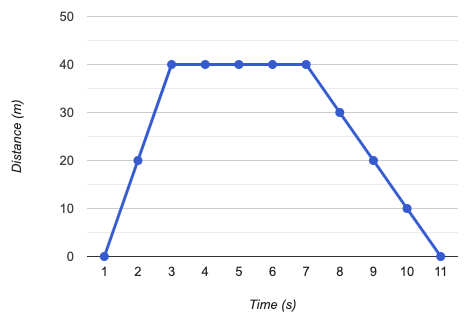
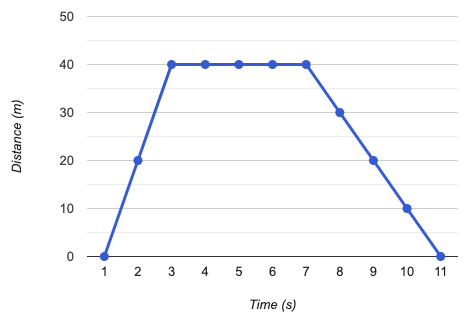
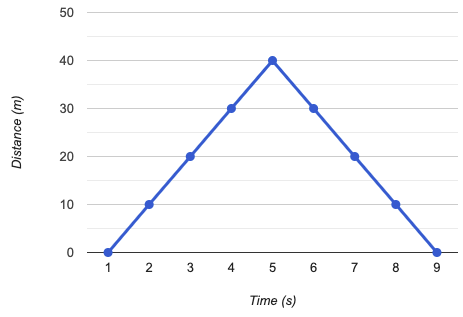
#34. Calculate the overall distance travelled by the object in the graph.

#35. What wavelength of the electromagnetic spectrum is useful for thermal imaging?

#36. What do we call energy that is stored inside atoms?

#37. Is this a parallel or series circuit?

#38. Kate and Emma both walk up 10 stairs, moving 4.5m higher than before. Emma does this in 2.7 seconds, Kate does this in 3.2 seconds. Which girl has exerted the most power?

#39. In longitudinal waves are the vibrations parallel or at right angles to the direction of wave travel?

#40. What is this component?

#41. Are voltmeters connected in parallel or series?

#42. How is fossil fuel usage changing as a percentage of total energy production worldwide?

#43. A crane raises a concrete bucket 12m into the air. The bucket including the cement weighs 850N. Calculate the work done. Answer to 1d.p and include the units. ? Do not include your workings in your answer

#44. What is acceleration?

#45. Calculate the change in height of the tennis ball in the following scenario. A ball weighs 0.15kg – the change in GPE is 100 J – the gravitational field strength is 10N/kg. Answer to 1dp and include units. ? If you do not know the GPE equation, it is listed below the quiz

#46. Our eyes can detect certain frequencies of light, what do we call these frequencies?

#47. Vectors have which of the following quantities?

#48. What state of matter has particles which are close together and move around each other?

#49. With electromagnetism the direction of the current depends on which of the following?

#50. Which of the following is an advantage of non-renewable energy sources?

#51. Which of the following is a disadvantage of solar panels?

#52. What is the function of an ammeter?

#53. What wavelength of the electromagnetic spectrum is useful for cooking?

#54. What is this component?

#55. Complete the sentence: different substances may absorb, transmit, refract or reflect electromagnetic waves in ways that vary with …….

#56. Which of the following equations is the correct way to make A the subject of the equation F = MA?

Take a look at this video on rearranging equations if you got this one wrong.

YouTube video

#57. What is wavelength?

#58. How is gravitational potential energy stored?

#59. When objects with motion collide, the total momentum will be the same after the collision as before the collision. There is no change in overall momentum. What do we call this Law of Physics?

#60. Waves that pass a boundary between two materials change speed and also change direction. What is this change of direction called?

#61. Which form of radiation is most ionising?

#62. Is speed a vector or a scalar?

#63. What is gamma radiation?

#64. What is the function of a variable resistor?

#65. What is this component?

#66. Steel is a magnetic material – true or false?

#67. Is velocity a vector or a scalar?

#68. Calculate the force when an object changes its momentum by 2550 kg m/s in 5 seconds. Include the units for force in your answer.

#69. Is this statement correct? When measuring momentum, if two objects are travelling in opposite directions, one object will be given a negative momentum (e.g. – 250 kg m/s).

#70. Complete the equation for power. Power (W) = work done (J) / ……..

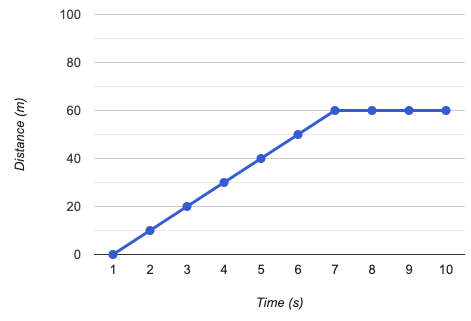
#71. Calculate the acceleration of the object in the graph between 5 and 6 seconds.

This is a straight-line graph.

Calculate the gradient of a straight-line graph using the following:

y₂ – y₁ / x₂ – x₁

30-20/6-5 = 10m/s²

This is the same as a simpler version:

Rise/run

or vertical distance / horizontal distance

#72. Is acceleration a vector or a scalar?

#73. Calculate the forces involved in an accident where a 1650 kg car travelling at 20 m/s hits a wall and the car comes to a stop in 0.05 seconds. Use the following equation: Force = mass x final velocity – mass x initial velocity / t (include units in your answer)

#74. Which greek letter represents density?

#75. Do light waves speed up or slow down then they go from air into water?

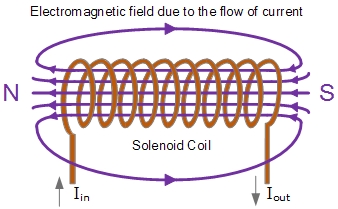
#76. If a current travelling along a wire changes direction, does the magnetic field also change direction?

#77. Magnets can attract magnetic materials – true or false?

#78. Nickel is a magnetic material – true or false?

#79. Are electromagnetic waves transverse or longitudinal?

#80. Energy can be transferred to useful and non-useful forms. Which of the following are non-useful transfers of energy?

Select all that apply:

#81. If an object is moving in a circular path – what is happening to its velocity?

#82. Are biofuels renewable?

#83. What is the source of energy for the sun?

#84. Which theory do we use to describe states of matter?

#85. How many planets are there in the Solar System?

#86. Is hydroelectric renewable?

#87. What is this component?

#88. True or False – Scalar quantities only have magnitude?

#89. Which of these is an example of transverse waves?

#90. What is the approximate radius of an atom?

Previous
Finish