GCSE OCR Combined Science B Papers 2 and 6

Mock test. 1 hour and 45 minutes. 95 marks available.

Each time the test is taken it will present different questions.

 
QUIZ START

Results

Well Done you passed the test! You’re on your way to getting the grades you want!
OCR Combined Science B Papers 2 and 6

Why not try another Science Mock Exam and see how well you do?

Nice try, check your answers to see where you went wrong.

OCR Combined Science B Papers 2 and 6

Why not get a bit more practice with some chemistry quizzes and then come back and have another try!

#1. After paper chromatography has been carried out, the paper is known as?

#2. Which type of reaction takes in energy, making the surroundings cooler?

#3. Can strong and weak acids have the same pH?

#4. What is the formula for hydrochloric acid?

#5. What are negative ions called?

#6. Which of these are common properties of simple molecular (covalent) materials?

Select all that apply:

#7. Are metals usually good conductors of heat?

#8. During a neutralisation reaction which salt is formed from sulfuric acid?

#9. Why do we use distilled water for chemical analysis?

#10. What is an electrolyte?

#11. Which of the following descriptions matches the Aᵣ of an element?

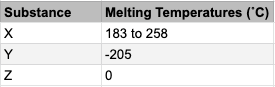
#12. The table shows 3 substances and their melting points. Which type of substance is X?

#13. Which of the following describe the composition of a pure substance?

Select all that apply:

#14. Solutions of less than pH 7 are?

#15. What is the chemical symbol for iodine?

#16. What is the symbol for relative atomic mass?

#17. What is the chemical symbol for fluorine?

#18. What type of substance is the air?

Select all that apply:

#19. Energy is transferred between the environment and reactants during a chemical reaction. What form is this energy usually in?

#20. Greenhouse effect 2) Fill in the blanks: Greenhouse gases such as ……….. , …………. and ……….. absorb infrared radiation from the Earth and re-emit it back to the Earth’s surface, causing warming.

#21. True or false – Precipitation reactions can be either exothermic or endothermic.

#22. What do group one atoms do when they bond ionically with group 7 atoms?

#23. What is a polymer?

#24. Since metallically bonded atoms have a delocalised pool of electrons, these electrons are able to conduct ……

Select all that apply:

#25. Solutions of pH 7 are?

#26. What state of matter has particles which are close together and vibrate around fixed positions?

#27. Calculate the relative formula mass of carbon monoxide (CO) to 2 decimal places. Carbon Aᵣ = 12, Oxygen Aᵣ = 16.

#28. What is the name of the process by which salt is removed from water?

#29. Iron is turned into iron oxide when exposed to the air. This is a process also known as rusting. Is the rate of reaction fast or slow in rusting?

#30. What is the formula for calcium hydroxide?

#31. The graph shows a heating curve for substance X (red) and substance Y (blue). Is substance Y a pure or impure substance?

#32. When a mixture of rocks, salt and water is filtered, what will be the residue?

#33. What is the approximate radius of an atom?

#34. Which of the following are strong acids?

Select all that apply:

#35. How did the oceans form?

#36. What is a solution called when it contains the maximum amount of solute that can dissolve in a solvent at a particular temperature?

#37. What is the evidence supporting the idea that there was very little oxygen in the atmosphere in Earth’s early atmosphere?

Select all that apply:

#38. In which type of reaction would the temperature of a solution increase?

#39. During electrolysis which electrode do anions and cations migrate to?

#40. What is the formula for the polyatomic ion nitrate?

#41. The melting point of gallium is 29.8˚C and the boiling point is 2204˚C. What state is gallium at 25˚C?

#42. Which of the following examples matches the composition of Earth’s early atmosphere?

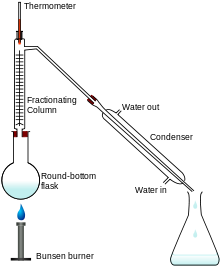
#43. Fractional distillation is used to separate which types of materials?

#44. Are non-metals usually malleable or brittle?

#45. If covalent bonds are very strong, then why does water have a low melting point?

#46. When there are more frequent collisions between particles, what will happen to the rate of reaction?

#47. What is the approximate radius of a nucleus?

#48. What temperature is the boiling point of water?

#49. When using inert electrodes to perform electrolysis with copper chloride solution, which products will be produced at the anode and cathode?

#50. Match the following description to the correct term. X is a mixture made of dissolved substances in a liquid.

#51. Chlorine has two stable isotopes, ³⁵Cl (75.77%) and ³⁷Cl (24.23%). Calculate the Aᵣ of chlorine to 2 decimal places.

#52. Is water an example of a covalent compound?

#53. Do metals usually have a high or low density?

#54. Do metals usually have a high or low melting point?

#55. Which types of atoms can be found in a pure piece of gold?

Select all that apply:

#56. During crystallisation, there is a risk of spitting which could cause harm. Which of the following could reduce the risk?

Select all that apply:

#57. Which of the following descriptions matches the term empirical formula?

#58. What is the formula for the compound calcium nitrate which is made of calcium and nitrate ions (NO₃⁻)?

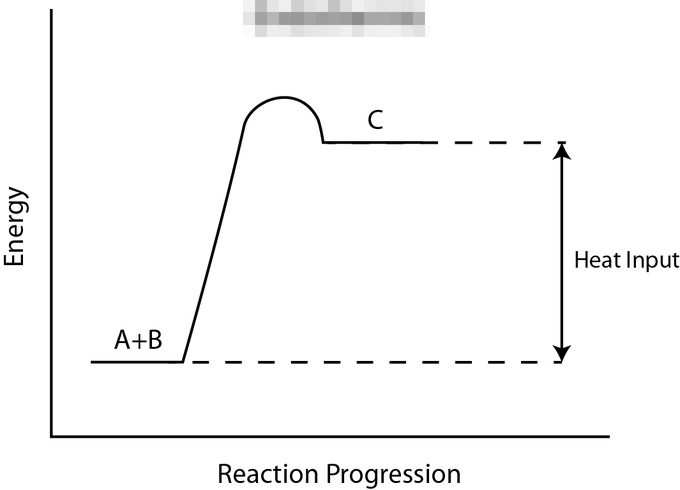
#59. Reaction profiles are used to show the energy transfers during reactions. Which type of reaction is shown in this reaction profile?

#60. Determine the empirical formula of glucose – C₆H₁₂O₆.

#61. The table shows 3 substances and their melting points. Which types of substances could Y be?

Select all that apply:

#62. True or false – You cannot use physical processes to separate mixtures into different substances.

#63. What is the chemical symbol for chlorine?

#64. Why are metals malleable?

#65. How do sodium and chlorine atoms bond? ? you might need a periodic table to answer this question

#66. What is the chemical symbol for sulfur?

#67. What is the boiling temperature of water?

#68. Why does graphite conduct electricity?

#69. Which of the following descriptions matches the Mᵣ of a compound?

#70. What method can we use to separate multiple types of liquids?

#71. In 1897 JJ. Thomson did a series of experiments that led to the discovery of which particles?

#72. Complete the equation: HCl (aq) + KOH(s) → ….. + …..

Select all that apply:

#73. Do non-metals usually have a high or low melting point?

#74. What is the chemical symbol for radon?

#75. What is the chemical symbol for mercury?

#76. Which of the following descriptions matches the term molecular formula?

#77. A soluble base is called?

#78. Why did the concentration of carbon dioxide in the atmosphere decrease after the oceans formed?

#79. During a neutralisation reaction which salt is formed from hydrochloric acid?

#80. When using inert electrodes to perform electrolysis with sodium chloride solution, which products will be produced at the anode and cathode?

#81. Which human activities cause increases in the greenhouse gases – carbon dioxide and methane?

Select all that apply:

#82. Are gases fluids?

#83. What the the least dense state of matter?

#84. Reaction profiles are used to show the energy transfers during reactions. Which type of reaction is shown in this reaction profile?

#85. Hydrogen has two stable isotopes, ¹H (abundance – 99.972%) and ²H (abundance – 0.001%). Calculate the Aᵣ of hydrogen. Answer to 3 decimal places.

#86. Which description best describes an element?

#87. Why is graphite softer than diamond?

#88. Complete the equation: HCl (aq) → H⁺(aq) + …..

#89. Are metals usually good conductors of electricity?

#90. What is the chemical symbol for phosphorus?

#91. Which of these is a problem with 3D ball and stick models?

#92. Fill in the blanks: Reduction refers to the …… of electrons and it occurs at the ……..

#93. What is the chemical symbol for sodium?

#94. Complete the following half equation for a reaction the cathode during electrolysis of molten zinc chloride. Zn²⁺ + ….. → Zn

#95. After filtering a mixture containing sand, salt and water using filter paper. What do we call what is left in the filter paper?

Previous
Finish