GCSE OCR Chemistry Papers 1 and 3

Mock test. 1 hour and 45 minutes. 90 marks available.

Each time the test is taken it will present different questions.

 
QUIZ START

Results

Well Done you passed the test! You’re on your way to getting the grades you want!
OCR Chemistry A Papers 1 and 3

Why not try another Science Mock Exam and see how well you do?

Nice try, check your answers to see where you went wrong.

OCR Chemistry A Papers 1 and 3

Why not get a bit more practice with some chemistry quizzes and then come back and have another try!

#1. During electrolysis which electrode do anions and cations migrate to?

#2. The distance travelled by a spot is determined by the solubility of the compound. How does solubility impact distance travelled?

#3. In aqueous solutions such as sodium chloride solution, there will be negatively charged ions from the salt (Cl⁻) as well as hydroxide ions (OH⁻). What is the rule that determines which will be discharged at the anode.

#4. What is the approximate radius of an atom?

#5. Are non-metals usually good conductors of electricity?

#6. What is the chemical symbol for oxygen?

#7. When using inert electrodes to perform electrolysis with molten lead bromide, which products will be produced at the anode and cathode?

#8. Why do both graphite and diamond have high melting points?

#9. Fill in the blanks: Reduction refers to the …… of electrons and it occurs at the ……..

#10. What is graphene?

#11. When using inert electrodes to perform electrolysis with water acidified with sulfuric acid, which products will be produced at the anode and cathode?

#12. What is the formula for calcium hydroxide?

#13. Which type of reaction takes in energy, making the surroundings cooler?

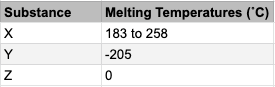
#14. The table shows 3 substances and their melting points. Which types of substances could Y be?

Select all that apply:

#15. Complete the equation: HCl (aq) → H⁺(aq) + …..

#16. What state of matter has particles which are far apart and move around independently?

#17. Determine the empirical formula for Cyanuric triazide – C₃N₁₂.

#18. Complete the following equation describing a reaction with a metal and an acid: metal + acid → …. + ….

Select all that apply:

#19. Complete the following half equation for a reaction the cathode during electrolysis of molten zinc chloride. Zn²⁺ + ….. → Zn

#20. The graph shows a heating curve for substance X (red) and substance Y (blue). Is substance X a pure or impure substance?

#21. What state of matter has particles which are close together and move around each other?

#22. Which three particles are atoms composed of?

#23. What is the chemical symbol for copper?

#24. What is the approximate radius of a nucleus?

#25. Strong acids do what in water? ? two words

#26. What is the relative mass of a neutron?

#27. Because mixtures contain more than one substance and each has its own melting point, mixtures melt in which way?

#28. Why does graphite conduct electricity?

#29. Why is magnesium a better electrical conductor than sodium?

#30. What is the equation for Rf values in paper chromatography?

#31. What is the charge of a proton?

#32. Which description most accurately describes covalent bonding

#33. Why are metals malleable?

#34. H₂SO₄(aq) + Na₂O(s) → …. + ….

Select all that apply:

#35. What are giant covalent structures?

#36. Which of the following describes the Plum Pudding Model of atomic structure?

#37. Which of the following descriptions matches the Mᵣ of a compound?

#38. A soluble base is called?

#39. What is the formula for the polyatomic ion carbonate?

#40. Which of these is a problem with dot and cross diagrams?

#41. Neutralisation reactions which occur between an acid and a base are always:

#42. Why is diamond hard?

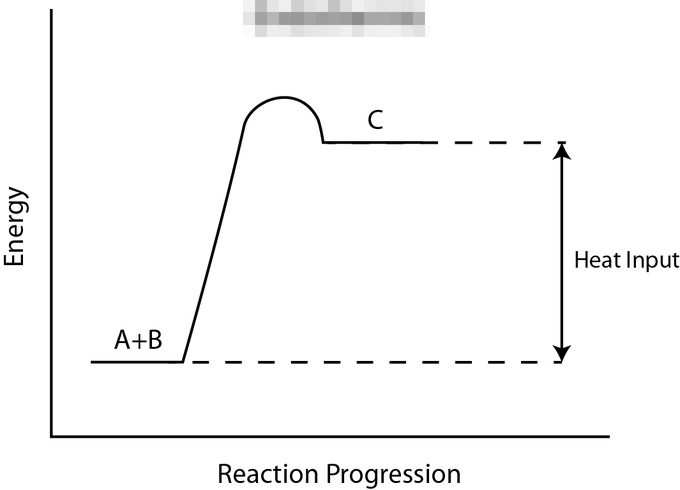
#43. Reaction profiles are used to show the energy transfers during reactions. Which type of reaction is shown in this reaction profile?

#44. Which of the following descriptions matches the term empirical formula?

#45. Fractional distillation is used to separate which types of materials?

#46. Which of these best describes metallic bonding?

#47. What type of substance is pure gold (Au)?

#48. Which of the following was the Rutherford Model of atomic structure?

#49. What is the chemical symbol for sodium?

#50. During a neutralisation reaction which salt is formed from nitric acid?

#51. Why is graphite softer than diamond?

#52. Since metallically bonded atoms have a delocalised pool of electrons, these electrons are able to conduct ……

Select all that apply:

#53. Solutions of pH 7 are?

#54. Which of the following are weak acids?

Select all that apply:

#55. Complete the equation: H⁺(aq) + OH⁻(aq) → ….

Remember:

acids produce an excess of hydrogen ions

alkalis produce an excess of hydroxide ions

hydrogen ions and hydroxide ions come together to make water which is neutral.

#56. What is the chemical symbol for iron?

#57. Can compounds be pure, for example, carbon dioxide?

#58. Ernest Rutherford fired positive particles at a thin gold foil and showed that most of atoms is empty space. Which particles did he fire at the gold foil?

#59. Which description best describes mixtures?

#60. What is the chemical symbol for phosphorus?

#61. What is the formula for the polyatomic ion ammonium?

#62. What temperature is the boiling point of water?

#63. What is the chemical symbol for potassium?

#64. What is the relative mass of a proton?

#65. What is the symbol for relative atomic mass?

#66. In aqueous solutions such as sodium chloride solution, there will be positively charged ions from the salt (Na⁺) as well as hydrogen ions (H⁺). What is the rule that determines which will be discharged at the cathode.

#67. Alkalis produce an excess of what when they dissolve in water?

#68. What is the formula for sodium hydroxide?

#69. Complete the following equation describing a neutralisation reaction with a metal oxide: metal oxide + acid → …. + ….

Select all that apply:

#70. Copper can be purified using electrolysis of copper sulfate solution. For this process we use the setup in the image below. Complete the half equation for the reaction at the anode. Cu → ….. + …..

#71. What state of matter has particles which are close together and vibrate around fixed positions?

#72. What is the freezing point of water?

#73. Which types of atoms can be found in a pure piece of gold?

Select all that apply:

#74. What is the name of the phase change from gas to solid?

#75. What method can we use to separate multiple types of liquids?

#76. When using inert electrodes to perform electrolysis with copper chloride solution, which products will be produced at the anode and cathode?

#77. Complete the equation: H₂SO₄(aq) + ZnO(s) → …. + ….

Select all that apply:

#78. After paper chromatography has been carried out, the paper is known as?

#79. What do group one atoms do when they bond ionically with group 7 atoms?

#80. Can Rf values be higher than 1?

#81. What is an electrolyte?

#82. What is a solution called when it contains the maximum amount of solute that can dissolve in a solvent at a particular temperature?

#83. What is the chemical symbol for helium?

#84. Which of the following things were hypothesised by John Dalton in 1805? ? select 4 answers

Select all that apply:

#85. Which of these descriptions best describes fullerenes?

#86. What is the word equation for photosynthesis? ? In some examples you might also see sunlight and chlorophyll above and below the arrow.

#87. Chlorine has two stable isotopes, ³⁵Cl (75.77%) and ³⁷Cl (24.23%). Calculate the Aᵣ of chlorine to 2 decimal places.

#88. Determine the empirical formula for Cyclopentane – C₅H₁₀?

#89. Which of these is a problem with metallic models?

#90. What is the name of the phase change from solid to gas?

Previous
Finish